Tiếng Việt
How long do porcelain veneers last? Many people believe that veneers only last a few years before needing replacement—but is that really true? Let’s explore the lifespan of veneers in the article below.
How long do porcelain veneers last?
The average lifespan of porcelain veneers typically ranges from 10 to 20 years, depending on material quality, bonding technique, and post-treatment care. Under ideal conditions—when the enamel is healthy, the dentist follows proper surface preparation protocols, and medical-grade bonding agents are used—veneers can maintain both mechanical durability and natural aesthetics for a long time.
Reputable international studies such as Beier et al. (2012) and Layton et al. (2019) have confirmed the excellent longevity of porcelain veneers. Specifically, the survival rate after 10 years is around 94–96%, and after 15 years it remains approximately 85–90%.
These are very impressive figures, showing that when performed correctly, porcelain veneers can achieve durability comparable to—or even exceeding—other all-ceramic restorations such as crowns or inlays/onlays.
5 factors affecting how long porcelain veneers last
The lifespan of veneers depends not only on the material itself but also on the combination of technique, tooth condition, lifestyle habits, and maintenance. Below are the five most important factors, identified by dentists and clinical studies as having a direct impact on the actual durability of veneers.
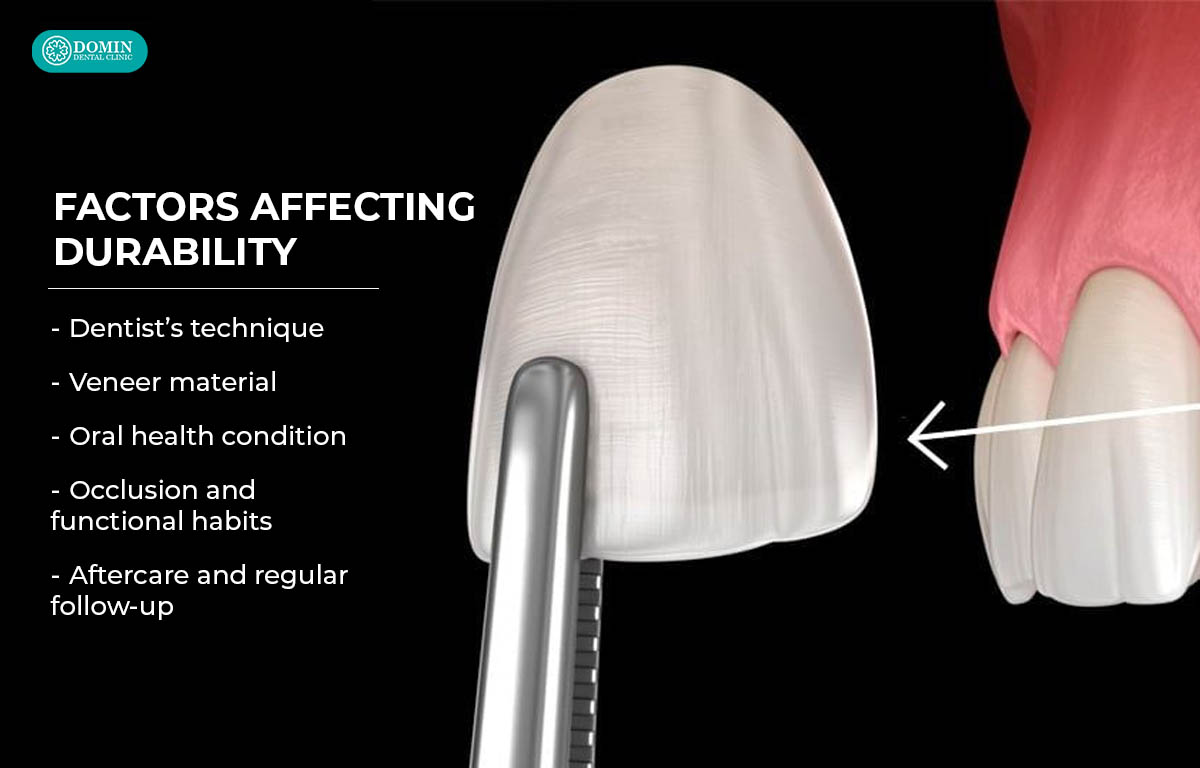
Dentist’s technique and initial diagnosis
This is the most decisive factor affecting the lifespan of veneers. From the diagnosis and treatment planning stage, the dentist must carefully analyze tooth structure, occlusion, enamel wear, and gum proportions to determine whether the patient is suitable for veneers or requires another option such as crowns.
Once the case is suitable, the execution technique becomes critical: from the amount of tooth reduction, maintaining veneer margins within enamel, to the surface treatment of both the tooth and veneer before bonding—all directly impact adhesion and durability.
A study on ResearchGate shows that veneers bonded to intact enamel have a lifespan 3–5 times longer than those bonded to dentin.
Therefore, preserving maximum enamel helps ensure veneers are more durable and less prone to debonding or fracture during chewing. If the entire process is performed correctly, veneers can maintain stable aesthetics and durability for 15–20 years, often without the need for replacement.
Veneer material

Veneer material is a key factor that directly determines the lifespan and aesthetic durability of the restoration.
Currently, lithium disilicate glass-ceramic such as Emax veneers is considered an optimal choice due to its flexural strength of around 400 MPa, excellent crack resistance, and long-term color stability.
In contrast, feldspathic porcelain offers high translucency and natural light effects, providing outstanding aesthetics, but it is more brittle and prone to chipping if not properly bonded. Meanwhile, composite veneers are a more cost-effective option, but their lifespan is only about 3–5 years, with significantly lower resistance to wear and color stability compared to porcelain.
Therefore, choosing the right material is a fundamental step in ensuring long-lasting and aesthetically pleasing veneers.
Oral condition
The condition of the natural teeth significantly affects bonding ability and veneer longevity. Veneers perform best when bonded to teeth with healthy enamel, minimal restorations, and no root canal treatment.
If the tooth surface is compromised or has undergone endodontic treatment, the bond strength between the veneer and the natural tooth is significantly reduced, increasing the risk of debonding or fracture over time.
In such cases, dentists often recommend crowns instead of veneers to ensure long-term stability and safety.
Occlusion and functional habits
When there is bite misalignment or habits such as grinding or clenching, veneers are subjected to excessive forces, especially at night when bite force can be 3–5 times higher than normal. This increases the risk of cracking, chipping, or debonding over time.
According to some references, to maintain long-term durability, dentists often recommend wearing a night guard to reduce force and protect veneers from excessive mechanical stress.
Oral care and regular follow-up
Poor oral hygiene allows plaque to accumulate around the gum margins, leading to gingivitis, cervical caries, and eventual veneer margin failure over time.
Dentists at Domin Dental Clinic recommend brushing twice daily with a soft-bristled toothbrush, using dental floss or a water flosser after meals, and scheduling polishing and occlusion checks every 6 months.
In practice, patients who maintain proper care and regular check-ups can keep their veneers in good condition for more than 15 years, minimizing the risk of debonding, discoloration, or damage.
How to maximize veneer longevity
To maintain both durability and natural aesthetics over time, patients need to combine proper clinical execution with good daily care habits. Below are important recommendations from experts:
1.Choose a reputable dentist and dental clinic: Veneers are only truly durable when placed with proper technique, with margins kept within enamel and bonding performed according to medical standards.

2. Preserve enamel as much as possible: Veneers bonded to natural enamel have 3–5 times higher adhesion than those bonded to dentin, which is a key factor for long-term durability.
3. Avoid harmful habits: Limit biting hard objects, teeth grinding, or using teeth to open bottles; if you have bruxism, wear a night guard.
4. Maintain proper oral hygiene: Brush twice a day with a soft-bristled toothbrush, and use dental floss or a water flosser to clean between teeth.
5. Schedule regular check-ups every 6 months: This allows the dentist to check occlusion, polish veneers, and detect early signs of margin failure or gum inflammation.
When all these factors are followed, veneers can maintain their beauty, brightness, and mechanical durability for over 15–20 years, often without needing replacement.
In summary: How long do porcelain veneers last? Their lifespan can range from 10 to 20 years or more when properly performed and maintained. This is not just a statistic, but proof of the harmony between dental expertise and individual care habits. If you have any questions or concerns, please contact Domin Aesthetic Dental Clinic for support!